
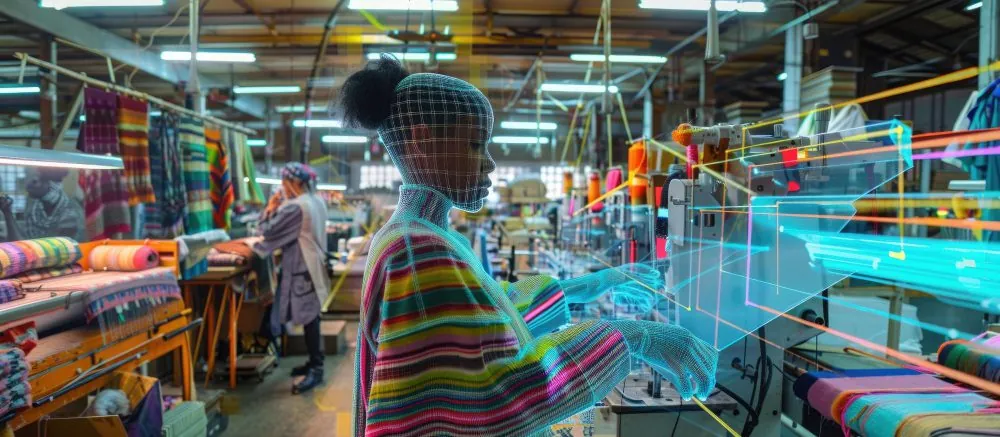
Let’s start with a simple picture.
A few generations ago, the weaver was the “full-stack” creator. They owned the loom, knew the patterns, understood their customer, and took pride in every piece.
Then large power looms arrived.
Production moved into factories.
Ownership shifted to a few mill owners.
Cloth became cheaper.
But the weaver lost control, status, and eventually, their livelihood.
Today, artificial intelligence (AI) is the new power loom. And the modern “weaver” is the knowledge worker: coders, designers, marketers, analysts, customer support agents, even doctors and lawyers.
The question is not: “Will AI take jobs?”
The real question is:Will we repeat the weavers’ story, or design a better one?
This article is about that choice.
What really happened to the weavers
Weavers did not lose only because machines were faster. They lost because the rules around the machines were stacked against them.
Work moved from homes to factories.
The weaver stopped being an owner and became a wage worker.
Speed and volume exploded.
One machine replaced many human hands. Price fell, but so did bargaining power.
Policy favoured mills, not artisans.
In many regions, including India, colonial and industrial policies nudged capital and protection towards factories, not craft clusters.
Brand and customer access moved away.
Traders, exporters, and later global brands controlled the story and the margin.
The result:
Our cupboards filled with clothes. But the people who once wove stories into fabric were slowly pushed to the margins.
That was not “inevitable progress.” It was a design choice.
The same pattern is now forming with AI
Today, the “loom” is:
- AI coding assistants
- Content generators
- Automation platforms
- Decision-support engines
- Multi-agent systems running quietly in the background
And the “weavers” are:
- Software developers
- Graphic designers
- Copywriters & Account managers
- Finance executives & Operations teams
- Even senior professionals like doctors, consultants, and lawyers
You can already see the pattern: Tasks are being automated. Fewer people can handle more work. Some companies quietly explore “do we still need this many humans?”
If we are not careful, we will get: Cheaper services and faster outputs. But a generation of professionals who feel replaceable, anxious, and disconnected from meaning.
We will have “cupboards full of content, code, and dashboards” — and a workforce that feels as invisible as the weavers became.
Bettroi was created to break that pattern.
The principle: AI should compress drudgery, not dignity
At Bettroi, our starting point is simple: Let AI kill the boring work. Let humans grow in judgment, empathy, and creativity.
AI is powerful at:
- Repetitive work
- Pattern recognition
- Drafting and redrafting
- Searching and sorting
- Basic decision rules
Humans are powerful at:
- Understanding context
- Holding conflicting priorities
- Navigating emotions
- Building trust
- Taking responsibility
The problem begins when we use AI to remove people, not just painful tasks.
“How do I use AI to upgrade my people, not downgrade them to a risk line on a spreadsheet?”
— The real design question for every founder.
A simple test: the LOOM framework
We use a simple filter at Bettroi when designing AI systems. For any AI initiative, ask:
LLeverage
Does AI reduce low-value manual effort and free humans for higher-value work?
Or are we just squeezing more output from the same person with less joy?
OOwnership
Who owns the data, workflows, and upside? Only the platform and the investor?
Or do employees and the business retain control, portability, and negotiating power?
OOptions
Does this give the workforce more career options, new roles, and new skills?
Or does it trap them into narrower, more mechanical work?
MMobility
Can skills developed with this AI migrate with the person?
Or are they locked into one vendor, one tool, one fragile setup?
If your AI roadmap fails on LOOM, you are setting up your own weavers’ story.
Maybe slower. But just as painful.
What leaders can do differently now
Here is how founders and leaders can avoid repeating history.
Design new roles, not just cut old ones
When you bring AI into your business, do not announce: “We will reduce headcount by 30 percent.” Instead, define new roles explicitly:
AI Conductorthe person who knows which AI tools to use, how to use them, and where to draw the line.
Workflow Designersomeone who maps processes and redesigns them with AI in the loop.
Outcome Ownerteam members measured by results (customer happiness, time-to-delivery, error rates), not by low-level task volume.
If you do not name these roles, people will assume AI is here to replace them, not promote them.
Create an “AI dividend for people”
When AI improves productivity or cuts cost, treat it like this: Measure the gain. Decide openly how much goes to:
- Company margin
- Reinvestment into new products or markets
- People: upskilling, new roles, bonuses, or safety nets
When we work with clients, Bettroi actively recommends an “AI dividend for people” model. Because if all the gain goes to the top, resentment builds at the bottom. You can see that story across industries already.
Make upskilling a core part of the transformation
Do not simply give your team a tool login and a two-hour training. Instead:
Build a 3–6 month AI learning plan inside your company. Make sure every role is taught:
- How to use AI tools in their daily work
- How to check and correct AI output
- How their role is evolving, not disappearing
If weavers had been invited to own, learn, and direct the new machines, their story would be different. Offer that chance to your people now.
What workers and professionals must do for themselves
This is not only a founder or CXO problem. Every professional also has a choice. You can either compete against AI or work above it.
Move from “I do X task” to “I own Y outcome.”
Example: not “I make reports,” but “I ensure leaders have the right decision-ready insights each week.”
Use AI every day in your work.
Treat it as your junior assistant. Audit its output. Learn its blind spots. Over time, your value becomes your judgment, not just your speed.
Build a visible “brainprint.”
Share your thinking through internal notes, LinkedIn posts, talks, or workshops. Show that you understand both your domain and AI.
Stay curious about the whole system.
Learn how your tasks connect to sales, customer experience, finance, and risk. The more you see the full fabric, the harder it is to replace you with a narrow tool.
You are not just a “doer” unless you agree to be one.
What Bettroi is committing to
Bettroi positions itself clearly: We are an AI and business orchestration studio. That means we sit at the junction of:
TechnologyCustomer experienceSales and revenueHuman systemsOur internal promise, now made public:
- We will use AI to remove drudgery for our team and our clients’ teams.
- We will not design systems that quietly erase people without a transition plan.
- We will bring a “people and change” lens into every serious AI proposal we deliver.
- We will push for transparency, data protection, and long-term flexibility, not vendor lock-in where possible.
We want AI to be the loom weavers own this time. Not another machine that pushes them out of the story.
If you are a founder or leader reading this
Ask yourself three simple questions:
If AI made your operations 30 percent more efficient, what would you do with the freed capacity?
Fire people? Or build new value?
Do your people know how their roles will change with AI?
Or are they guessing, afraid, and silently resisting?
Are you designing AI so that your business becomes more human in how it treats customers and employees?
Or only more mechanical and efficient?
If you want to explore AI in a way that does not create new weavers’ tragedies, Bettroi will help you design that path.
Technology will keep moving. The question is whether our systems and conscience move with it.